Why Your Body Struggles to Burn Fat (And How to Fix It)
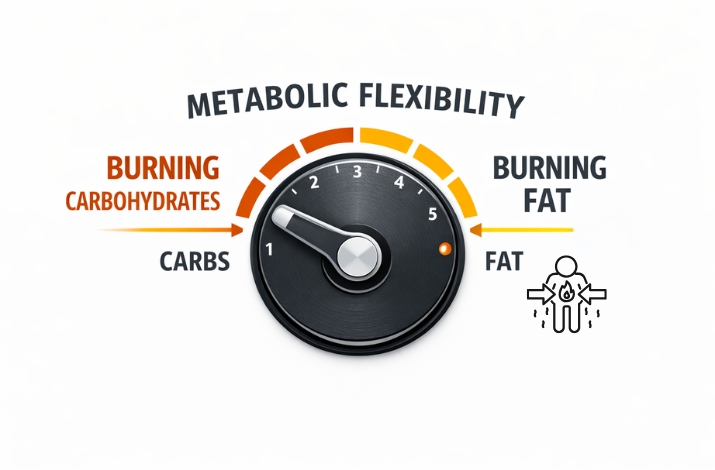
For decades, we were told carbs were the problem. Before that, we were told fat was the problem. Many people still argue that the issue is solely calories. Meanwhile, metabolic diseases skyrocketed. What if the real issue is not a single macronutrient, but how “metabolically flexible” an individual is [1,2,3]?
What does metabolically flexible even mean? Metabolic flexibility is your body’s ability to switch between burning carbohydrates and burning fat depending on energy availability and demand [1,2,3].
Throughout the day, several physiological challenges arise in meeting energy demand. During fasting, metabolically flexible individuals can tap into fat oxidation (burning). During feeding or insulin-stimulated conditions, they switch to carbohydrate oxidation. The purpose of these mechanisms is to maintain energy equilibrium during caloric excess and restriction, as well as during varying energy demands such as exercise [1,3,4].
If a person has relatively good metabolic flexibility, after a high-carbohydrate meal, their muscle cells respond quickly to insulin. GLUT4 transporters move to the cell surface, glucose enters the cell, and it is stored as glycogen for energy or to maintain blood glucose between meals. Fat oxidation, or the conversion of fat into energy, temporarily decreases when insulin levels rise [5,6].
As mentioned, in someone who is metabolically flexible, this is a normal, efficient switch without prolonged insulin elevation or crash. When that person is not eating, or is in a fasted state, insulin falls, glucagon rises, and stored glycogen is used [1,2]. Once glycogen is depleted, the body increases lipolysis (the breakdown of stored fat into free fatty acids), which are further metabolized to ultimately produce energy. In situations where carbohydrate intake is lower or fasting is extended, the liver increases ketone production from fatty acids. This is nothing extreme; it is simply physiology. A metabolically flexible body can transition between glucose and fat oxidation without energy collapse [1,2,3,].

Now, let’s talk about what happens when metabolic flexibility is lost. Metabolic inflexibility is the body’s impaired ability to switch between energy sources, characteristic of conditions such as obesity, insulin resistance, and type 2 diabetes. One proposed mechanism at the center of this shift involves chronic hyperinsulinemia [13,18]. When insulin remains elevated for long periods, often due to repeated high-sugar intake, constant snacking, sedentary behavior, poor sleep, and chronic stress, several changes begin to occur. Skeletal muscle becomes far less sensitive to insulin, insulin stays elevated longer, and lipolysis (burning fat for fuel) is suppressed. The metabolic flexibility “switch” is essentially stuck in glucose-priority mode [2,3, ,6].
Over time, these processes promote visceral fat accumulation, which begins secreting inflammatory cytokines and further impairs insulin signaling. This leads to higher insulin, more fat storage, more inflammation, worsening insulin sensitivity, and even higher insulin levels. The tragedy of metabolic inflexibility is not that the body can’t burn carbohydrates; it is that it struggles to burn fat when it needs to [17].
Why should you feel empowered when it comes to metabolic flexibility? There are many ways to improve it. Let’s start with building skeletal muscle, one of the most effective strategies overall. Muscle is the primary site of glucose disposal; roughly 70–80% of post-meal glucose is taken up by muscle tissue. More muscle means a larger carbohydrate metabolic reservoir. Habitual physical activity is one of the primary determinants of metabolic flexibility [5,7,8,9,12].
Higher protein intake is also associated with greater metabolic flexibility, with at least 20–30 grams per meal optimizing metabolic signaling pathways [10]. Carbohydrate restriction, particularly of refined carbohydrates and added sugars, may improve metabolic flexibility and reduce insulin-mediated suppression of fat oxidation [11,13].
Chronic short sleep reduces insulin sensitivity and increases insulin resistance, impairing the body’s ability to switch between glucose and fat as fuel. Sleep loss also raises ghrelin, lowers leptin, and increases cravings and calorie intake, reinforcing metabolic inflexibility [14,15].
Psychosocial stress impairs metabolic flexibility by promoting insulin resistance and disrupting glucose and lipid regulation. Over time, sustained stress is associated with accelerated cellular aging and increased risk of metabolic conditions such as diabetes and fatty liver disease [16].
Lastly, reducing snacking frequency, even without lowering total calories, may improve metabolic flexibility by enhancing insulin sensitivity, reducing inflammation, and restoring healthy gut and circadian rhythms [17,18].
Metabolic flexibility is not about fearing carbohydrates, fat, or calories. It is about restoring the body’s ability to use both glucose and fat efficiently, as it was designed to do. When muscle is strong, sleep is sufficient, stress is managed, protein intake is adequate, and eating patterns allow insulin to rise and fall in a rhythmic pattern, the metabolic switch works smoothly. Health is not found in rigid restriction, but in rebuilding the capacity to transition between fuels without dysfunction. A protein-forward, strategically lower-carbohydrate approach can be a powerful tool for restoring that flexibility, not because carbohydrates are inherently harmful, but because metabolic resilience must first be rebuilt before they can be handled well [1,2].
References
-
- Smith RL, Soeters MR, Wüst RCI, Houtkooper RH. Metabolic flexibility as an adaptation to energy resources and requirements in health and disease. Endocr Rev. 2018.
- Galgani JE, Fernández-Verdejo R. Pathophysiological role of metabolic flexibility on metabolic health. Obes Rev. 2021.
- Goodpaster BH, Sparks LM. Metabolic flexibility in health and disease. Cell Metab. 2017.
- Chomentowski P, Coen PM, Radiková Z, Goodpaster BH, Toledo FGS. Skeletal muscle mitochondria in insulin resistance: differences in intermyofibrillar versus subsarcolemmal subpopulations and relationship to metabolic flexibility. J Clin Endocrinol Metab. 2011.
- Richter EA, Bilan PJ, Klip A. A comprehensive view of muscle glucose uptake: regulation by insulin, contractile activity, and exercise. Physiol Rev. 2025.
- Sylow L, Tokarz VL, Richter EA, Klip A. The many actions of insulin in skeletal muscle, the paramount tissue determining glycemia. Cell Metab. 2021.
- Kanaley JA, Colberg SR, Corcoran MH, et al. Exercise/physical activity in individuals with type 2 diabetes: a consensus statement from the American College of Sports Medicine. Med Sci Sports Exerc. 2022.
- Paquin J, Tremblay R, Islam H, et al. Resistance training, skeletal muscle hypertrophy, and glucose homeostasis: how related are they? A systematic review and meta-analysis. Appl Physiol Nutr Metab. 2024.
- Wang J, Fan S, Wang J, et al. Resistance training enhances metabolic and muscular health and reduces systemic inflammation in middle-aged and older adults with type 2 diabetes: a meta-analysis. Diabetes Res Clin Pract. 2025.
- González-Salazar LE, Pichardo-Ontiveros E, Palacios-González B, et al. Effect of the intake of dietary protein on insulin resistance in subjects with obesity: a randomized controlled clinical trial. Eur J Nutr. 2021.
- Biyikoglu H, Robertson MD, Collins AL. Isolating the acute metabolic effects of carbohydrate restriction on postprandial metabolism with or without energy restriction: a crossover study. Eur J Nutr. 2025.
- Ludwig DS, Ebbeling CB. The carbohydrate-insulin model of obesity: beyond “calories in, calories out.” JAMA Intern Med. 2018.
- Sondrup N, Termannsen AD, Eriksen JN, et al. Effects of sleep manipulation on markers of insulin sensitivity: a systematic review and meta-analysis of randomized controlled trials. Sleep Med Rev. 2022.
- Zuraikat FM, Laferrère B, Cheng B, et al. Chronic insufficient sleep in women impairs insulin sensitivity independent of adiposity changes: results of a randomized trial. Diabetes Care. 2023.
- Sunena, Mishra DN. Stress etiology of type 2 diabetes. Curr Diabetes Rev. 2022.
- Gómez-Ruiz RP, Cabello-Hernández AI, Gómez-Pérez FJ, Gómez-Sámano MÁ. Meal frequency strategies for the management of type 2 diabetes subjects: a systematic review. PLoS One. 2023.
- Santoro A, Kahn BB. Adipocyte regulation of insulin sensitivity and the risk of type 2 diabetes. N Engl J Med. 2023.
- Xing J, Chen C. Hyperinsulinemia: beneficial or harmful or both on glucose homeostasis. Am J Physiol Endocrinol Metab. 2022.
This article is for informational and educational purposes only. It is not, nor is it intended to be substitute for professional medical advice, diagnosis, or treatment and should never be relied upon for specific medical advice.


Most Popular