How Protein Became Nutrition’s Most Important Nutrient
The science behind today’s protein obsession, and why it has transformed the global food industry
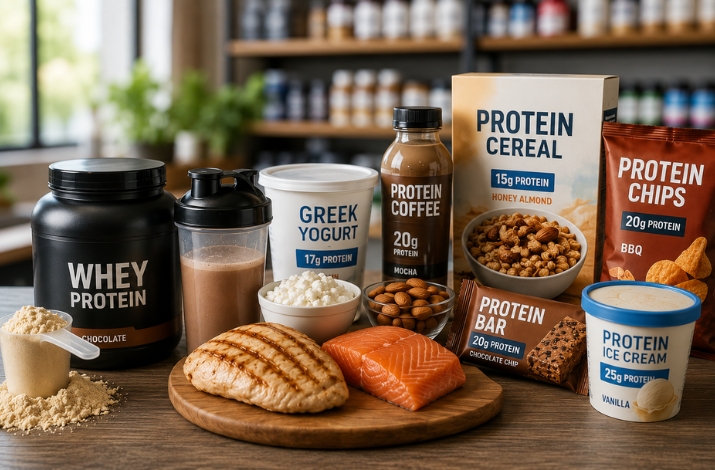
If you’ve walked through a grocery store lately, you’ve probably noticed something strange. Suddenly, everything has protein. Coffee has protein. Pancakes have protein. Popcorn has protein. Ice cream has protein. Even breakfast cereal, once marketed as a source of whole grains, now competes on grams of protein.
This isn’t just clever marketing. It’s the downstream effect of one of the biggest shifts in nutrition science over the past twenty years.
On social media, this movement has earned a nickname: protein maxxing. The idea is simple. Rather than treating protein as something reserved for athletes and bodybuilders, people intentionally look for opportunities to increase their protein intake throughout the day.
Like many online trends, protein maxxing has attracted both excitement and criticism. Some dismiss it as another nutrition fad that will eventually fade away. But unlike many viral health trends, this one didn’t begin on social media.
It began in research laboratories.
Over the past two decades, scientists studying obesity, metabolism, exercise physiology, and healthy aging have steadily expanded our understanding of protein. What they discovered challenged many long-held assumptions about nutrition. Protein wasn’t simply the nutrient that helped bodybuilders build muscle. It also played an important role in maintaining lean body mass during weight loss, promoting satiety, supporting healthy aging, and preserving physical function throughout life.[1, 2, 3, 4]
As those discoveries filtered into physician offices, dietitians’ recommendations, fitness programs, and eventually mainstream media, consumers changed the way they shopped.
The result has been one of the most significant shifts in modern nutrition. Protein has gone from being a niche sports nutrition ingredient to becoming one of the most sought-after nutrients in the world.
Ironically, that success has created an entirely new challenge. As millions of people simultaneously increased their demand for high-quality protein, manufacturers across nearly every food category found themselves competing for the same ingredients. Nowhere has that demand been felt more than in the market for whey protein.
Why the Science Changed
For decades, nutrition conversations focused primarily on calories and fat. Protein was certainly recognized as essential, but it was rarely the centerpiece of dietary advice for the average person.
That began to change as researchers started looking beyond body weight and asking more sophisticated questions.
Instead of simply measuring how many pounds people lost, scientists began examining what kind of weight they lost. Instead of studying lifespan alone, they investigated healthspan and physical function. Researchers studying appetite looked beyond calories and explored how different macronutrients influenced hunger and satiety.
Again and again, protein emerged as an important part of the answer.
Higher-protein diets consistently demonstrated advantages for preserving lean body mass during weight loss, helping maintain muscle while body fat declined.[5] Protein-rich meals also promoted greater feelings of fullness than meals emphasizing carbohydrates or fat, in part because protein stimulates hormones involved in satiety while suppressing hunger signals.[6] Researchers also found that protein requires more energy to digest than the other macronutrients, contributing modestly to daily energy expenditure.[7]
Perhaps the most important discoveries involved aging.
Beginning around the age of 30, adults gradually lose skeletal muscle, and that decline accelerates later in life. Maintaining muscle isn’t simply about strength or appearance. Muscle supports balance, mobility, metabolic health, and independence as we age.[8] Research has shown that older adults often benefit from consuming more high-quality protein than younger adults because aging muscles become less responsive to the normal signals that stimulate muscle protein synthesis.[9]
Taken together, these findings fundamentally changed the conversation around protein.
Instead of viewing protein as something primarily for athletes, nutrition experts increasingly began discussing it as an essential nutrient for healthy aging, weight management, exercise recovery, and overall metabolic health.
Consumers responded.
Why Whey Rose to the Top
As interest in protein grew, another question naturally followed.
If people are trying to eat more protein, does the type of protein matter?
The answer is yes.
All proteins provide amino acids, but they differ in digestibility and in the proportions of the nine essential amino acids that the body cannot produce on its own.[10] Higher-quality proteins generally provide these amino acids in amounts that closely match human needs while also being efficiently digested and absorbed.
Among the many protein sources available, whey attracted particular scientific attention.
Whey is one of the two naturally occurring proteins found in milk, accounting for roughly 20 percent of milk’s total protein, with casein making up the remainder.[11] During cheese production, whey remains in the liquid portion after the curds are separated. For generations, this liquid had relatively little value. Today, it has become one of the most extensively studied protein ingredients in nutrition science.
Researchers were drawn to whey because it combines several desirable characteristics. It is a complete protein, contains relatively high amounts of the essential amino acid leucine, and is rapidly digested, allowing amino acids to become available quickly after consumption.[12,13] These qualities made it an ideal protein for studying muscle protein synthesis, recovery, and body composition.
That extensive body of research also gave food manufacturers confidence.
As consumer demand for higher-protein foods accelerated, manufacturers needed an ingredient that could increase protein content while maintaining taste, texture, and product quality. Whey proved remarkably versatile. It blended well into beverages, dairy products, nutrition bars, meal replacements, and many baked goods without dramatically changing the eating experience.
Before long, whey had expanded far beyond protein powders.
It became an ingredient in Greek yogurt, ready-to-drink coffees, breakfast cereals, frozen meals, protein snacks, and dozens of other foods that most consumers wouldn’t traditionally associate with sports nutrition.
The modern grocery store had quietly entered the protein era.
The consequences of that transformation, however, extended far beyond supermarket shelves.
When Science Changed the Marketplace
Scientific discoveries don’t usually transform grocery stores. Most remain confined to research journals, medical conferences, and clinical practice. Every so often, however, enough independent discoveries point in the same direction that they begin to change how millions of people think about food. When that happens, the effects extend far beyond nutrition. They influence consumer behavior, product development, manufacturing, and eventually entire industries.
That’s exactly what happened with protein.
The surge in demand wasn’t driven by a single study or one viral social media trend. Instead, several independent movements converged at roughly the same time.
Strength training became increasingly mainstream, with physicians and public health organizations recommending resistance exercise for people of nearly every age. Researchers studying healthy aging emphasized the importance of preserving muscle throughout life. Weight-loss specialists shifted their focus from simply reducing body weight to improving body composition by maintaining lean mass while losing fat. More recently, healthcare providers began encouraging people using GLP-1 medications to prioritize protein intake to help preserve muscle as calorie intake declines.
Each of these developments reached a different audience, yet they all delivered a remarkably similar message: consume enough high-quality protein.
At the same time, consumers began seeking foods that offered more than just convenience. They wanted products that aligned with their health goals. Manufacturers responded by reformulating existing foods and developing entirely new ones with higher protein content.
Today’s grocery store reflects that transformation. Greek yogurt has become one of the fastest-growing segments of the dairy aisle. Protein coffees occupy refrigerated beverage cases. Frozen breakfast products, snack foods, cereals, and convenience meals increasingly compete on protein content. What was once largely confined to sports nutrition has become a defining feature of mainstream food manufacturing.
Why Whey Demand Grew So Quickly
As manufacturers looked for practical ways to increase protein content, whey emerged as one of the industry’s preferred ingredients.
Its nutritional profile had already been well established through decades of clinical research. From a food science perspective, it also offered several advantages. Whey mixes well into beverages, works effectively in dairy products and baked foods, and allows manufacturers to significantly increase protein content without dramatically altering taste or texture.
As a result, companies across virtually every category began using it.
This created an unusual situation. Sports nutrition brands were no longer the primary purchasers of whey protein. They were now competing with yogurt manufacturers, breakfast cereal companies, ready-to-drink beverage producers, meal replacement companies, medical nutrition manufacturers, and countless other food producers.
Instead of demand increasing in one corner of the market, it increased almost everywhere at once.
Why Supply Couldn’t Keep Pace
This raises an obvious question.
If demand has increased so dramatically, why doesn’t the industry simply produce more whey protein?
The answer lies in how whey is made.
Unlike crops that can be planted in greater quantities from one growing season to the next, whey protein begins as part of the cheesemaking process. Liquid whey must then undergo multiple stages of filtration, concentration, purification, and drying before it becomes the high-quality whey protein concentrates and isolates used throughout the food industry.[11]
Expanding that production capacity isn’t simply a matter of running factories longer. It requires significant investments in specialized processing equipment, drying facilities, transportation infrastructure, quality-control systems, and skilled personnel. Designing, constructing, and commissioning these facilities takes years.
In other words, consumer demand can change much faster than manufacturing capacity.
That’s exactly what has happened over the past several years.
As demand for high-quality protein accelerated, ingredient suppliers found themselves serving more customers than ever before. Recent industry reporting has documented tighter inventories, rising ingredient costs, and increasing competition for premium whey proteins as processors work to expand capacity and meet growing demand.
Importantly, this doesn’t mean the world is “running out” of whey protein, nor does it suggest that protein-rich foods will disappear from store shelves. Rather, it reflects what economists often observe whenever demand rises more quickly than supply can reasonably expand.
The protein market is experiencing growing pains.
The Bigger Story Behind the Headlines
Viewed in isolation, recent headlines about whey shortages or higher ingredient prices can sound concerning.
Viewed in context, however, they tell a much more encouraging story.
They reflect the fact that nutrition science has successfully changed consumer behavior.
Twenty years ago, relatively few consumers gave much thought to the amount or quality of protein they consumed each day. Today, many intentionally choose foods that help support muscle health, healthy aging, satiety, exercise recovery, and overall nutritional quality. Those choices are increasingly informed by decades of peer-reviewed research rather than marketing alone.
The food industry has responded by investing heavily in higher-protein products, while dairy processors continue expanding their ability to produce the specialized whey ingredients those products require. As additional production capacity comes online over the coming years, the market will continue adapting to this new reality.
Perhaps the most important takeaway is that today’s protein boom isn’t being driven by a passing fad.
The phrase “protein maxxing” may eventually disappear, replaced by the next social media buzzword. But the scientific discoveries that inspired today’s interest in protein are unlikely to change. Our understanding of healthy aging, body composition, metabolism, and muscle physiology has advanced considerably, and those discoveries continue shaping nutritional recommendations around the world.
Protein hasn’t suddenly become important.
We’ve simply become much better at appreciating the role it has played all along.
The recent headlines about rising demand, tighter whey supplies, and higher prices are therefore not the beginning of the story. They’re the final chapter in a much larger narrative, one that began decades ago in research laboratories and ultimately changed how millions of people think about one of the most fundamental nutrients in the human diet.
References
-
-
- Leidy HJ, Clifton PM, Astrup A, et al. The role of protein in weight loss and maintenance. Am J Clin Nutr. 2015.
- Phillips SM. The impact of protein quality on the promotion of resistance exercise-induced changes in muscle mass. Nutr Metab (Lond). 2016.
- Wolfe RR. The role of dietary protein in optimizing muscle mass, function and health outcomes. Br J Nutr. 2012.
- Paddon-Jones D, Rasmussen BB. Dietary protein recommendations and the prevention of sarcopenia. Curr Opin Clin Nutr Metab Care. 2009.
- Wycherley TP, Moran LJ, Clifton PM, et al. Effects of energy-restricted high-protein diets on body composition. Am J Clin Nutr. 2012.
- Batterham RL, et al. Critical role for peptide YY in protein-mediated satiation. Cell Metab. 2006.
- Westerterp KR. Diet-induced thermogenesis. Nutr Metab. 2004.
- Cruz-Jentoft AJ, et al. Sarcopenia: Revised European consensus on definition and diagnosis. Age Ageing. 2019.
- Bauer J, et al. Evidence-based recommendations for optimal dietary protein intake in older people. J Am Med Dir Assoc. 2013.
- FAO. Dietary Protein Quality Evaluation in Human Nutrition. Food Nutr Bull. 2013.
- Walstra P, Wouters JTM, Geurts TJ. Dairy Science and Technology. 2nd ed. CRC Press. 2006.
- Norton LE, Layman DK. Leucine regulates translation initiation of protein synthesis in skeletal muscle. J Nutr. 2006.
- Tang JE, et al. Ingestion of whey hydrolysate, casein, or soy protein isolate: Effects on mixed muscle protein synthesis. J Appl Physiol. 2009.
-
This article is for informational and educational purposes only. It is not, nor is it intended to be substitute for professional medical advice, diagnosis, or treatment and should never be relied upon for specific medical advice.


Most Popular